

Emily is 54. She works at a distribution warehouse, thirty miles from the nearest clinic. She has type 2 diabetes and hypertension.
She hasn’t seen her primary care provider in over a year—not because she doesn’t want to, but because the earliest appointment is months out and she doesn’t yet know her work schedule. Losing a day’s wages is not an option.
Her blood pressure has been rising for months.
She knows it. She ignores it.
Then one Tuesday morning, she has a stroke.
She arrives in the emergency department. She spends eleven days inpatient. The total cost of care exceeds $180,000. She leaves with permanent neurological damage.
None of it needed to happen.
This isn’t a failure of awareness or compliance. It’s a failure of healthcare access.
Primary care wasn’t a viable option when it mattered.
The emergency department became the default—after the damage was already done.
This is what happens when every access point operates with constraints.
For employers, health systems, universities, and communities, this dynamic is no longer theoretical. It shows up every day in missed work, delayed care, rising costs, and avoidable utilization.
The scale is difficult to ignore:
At the same time, demand continues to accelerate:
This is not a single-point failure. It is a system operating without enough accessible, scalable capacity.
That constraint is rooted in how care is built and delivered.
Traditional healthcare depends on physical infrastructure—clinics, facilities, and staffed provider networks. And that model does not scale easily.
Building and operating a brick-and-mortar clinic requires significant investment and ongoing staffing, often reaching into the millions annually. Expanding that footprint takes time, capital, and access to a workforce that is already constrained.
At the same time, supply is tightening. The U.S. faces a growing physician shortage, while a significant portion of the current physician workforce is nearing retirement.
The result is a structural reality: capacity is not keeping pace with demand.
This is why access challenges persist—even in areas with established healthcare systems. The issue is not just where care exists, but how quickly it can scale to meet need.
Across most systems, the path to care is no longer linear—it’s a loop.
A virtual visit leads to an in-person follow-up, then a referral. In many cases, it starts in the emergency department, where patients turn when other access points aren’t available. From there, they’re directed back into the system for ongoing care.
Each step moves care forward but rarely resolves it end-to-end.
That loop is the result of a system where each care setting is optimized for a moment, but not for resolution.
Hospitals are designed for acute care, not ongoing access.
Urgent care prioritizes speed, not continuity.
Primary care delivers longitudinal care, but with limited capacity.
Virtual models expand access, but with limitations on clinical evaluation.
Each modality plays a role. But none are built to deliver access, assessment, and follow-through at the same time.
Emergency departments are designed for high-acuity care. But increasingly, they’re functioning as a default access point.
When 60–70% of visits are non-emergent and/or avoidable, EDs absorb demand they were never built to manage—driving cost, congestion, and clinician burnout. What should be a controlled environment for acute care becomes a pressure valve for the entire system. An estimated $168 billion is spent annually on avoidable emergency department visits, further amplifying strain on already overextended systems.
Federal requirements ensure that every patient who walks through the ED door is evaluated, regardless of need or ability to pay. In practice, that has positioned the ED as the most reliable access point in healthcare, especially when other options are unavailable, delayed, or difficult to navigate.
This isn’t just a capacity issue. It’s a routing problem.
Patients enter through the ED not because it’s the right setting, but because it’s the only setting that guarantees care. From there, health systems are forced to manage conditions that could have been addressed earlier, often at lower acuity and lower cost.
The downstream impact extends beyond overcrowding:
What looks like overuse is often a signal of something upstream: access that is too limited, too fragmented, or too slow to meet demand.
When that happens, the emergency department doesn’t just deliver care—it becomes the system’s default front door.
Urgent care improves convenience—but it remains inherently episodic.
Most visits are structured to resolve a single issue, often without full visibility into a patient’s broader history or underlying conditions. When additional evaluation is needed, patients are sent elsewhere, creating repeat visits, added cost, and fragmented care.
This isn’t just a continuity gap. It’s a limitation in scope.
Urgent care reduces friction at the front end, but it often shifts complexity downstream into follow-up appointments, additional referrals, or higher-acuity settings when conditions aren’t fully addressed the first time.
That pattern carries real cost implications:
Beyond clinical limitations, urgent care faces structural constraints that further limit its effectiveness.
Urgent care centers are expensive to build and operate, require consistent clinical staffing, and are difficult to scale across large or distributed populations. In many markets, particularly rural or underserved areas, the staffing model simply doesn’t pencil, leaving gaps in coverage where access is needed most.
Primary care remains the most effective and lowest-cost model in healthcare—when it’s accessible.
Right now, it often isn’t.
Provider shortages are already straining capacity across the system, with millions of Americans living in primary care shortage areas, and limited ability to expand supply. At the same time, demand is increasing, driven by aging populations, rising chronic disease, and greater utilization.
The result is a growing access gap.
Patients wait 31 to 90 days to see a physician—and that's if they can get an appointment at all. As the physician shortage widens, more doctors are simply not accepting new patients, leaving millions without a path to routine care. Timely access has become the exception rather than the norm.
This isn’t a failure of the model. It’s a failure of access.
When patients can’t get timely primary care, conditions go unmanaged, care is delayed, and costs rise as issues escalate into more acute interventions. What should be resolved early becomes something the system has to manage later—at higher cost and higher complexity.
Expanding traditional primary care capacity is inherently slow. Building clinics, recruiting providers, and scaling networks takes years—time most organizations don’t have as demand continues to accelerate.
The model is proven. But without access, it can’t function at the scale the system now requires.
Retail clinics provide convenient, walk-in care for common conditions, typically embedded within pharmacy or big-box retail environments.
While many can address a broad range of routine needs, they are fundamentally tied to a retail footprint, with hours, staffing, and availability dependent on store operations rather than patient demand across a broader population.
These clinics rely on on-site staffing models that can be difficult to maintain consistently, particularly in underserved or lower-volume areas. As a result, access can be uneven, and coverage does not extend reliably across regions where care gaps are most significant.
As a result, many visits become handoffs rather than resolutions, adding time, cost, and fragmentation when patients require follow-up, ongoing management, or more comprehensive evaluation.
The model is also built around direct-to-consumer utilization, limiting its ability to integrate with employer populations, health systems, or broader care networks at scale. Many retail clinics have struggled to sustain that business model. Recent retrenchment by major pharmacy chains, including clinic closures and reduced expansion, highlights these fundamental constraints.
Retail clinics improve access in specific locations.
They are not designed to provide consistent, system-level access across a population.
On-site clinics deliver meaningful value—but only when organizations have the scale and density to support them.
In the right environments, both employer-based clinics and campus health centers can improve utilization, reduce absenteeism, and deliver better outcomes by meeting people where they are.
However, those benefits are inherently limited by the operational and infrastructure requirements needed to build and sustain them.
Building and operating an on-site clinic requires significant capital investment, physical space, ongoing clinical staffing, and time to implement—often disrupting existing environments during buildout and requiring sustained operational investment over time.
Staffing introduces additional complexity. Supporting multiple shifts, distributed locations, or variable demand requires consistent provider coverage, which is difficult to maintain and often results in underutilization at some sites and gaps in access at others.
Most organizations cannot support a fully staffed clinic everywhere their population lives or works. A single clinic typically serves one site, creating a structural mismatch for distributed workforces and multi-campus environments.
As a result, access becomes uneven. Even when a clinic exists, large portions of the population remain unserved, creating a familiar tradeoff:
The impact of that uneven access is visible in how people experience care:
On-site clinics can be highly effective in the right conditions.
But they are difficult to deploy, staff, and sustain consistently across the distributed populations most organizations are trying to reach.
A patient completes a virtual visit in minutes.
But when the clinician needs to listen to lungs, capture vitals, or evaluate something more precisely, the outcome is familiar:
“Let’s schedule an in-person follow-up.”
Access was solved for some, but not most.
Assessment was not.
This is the core limitation of most telehealth models—the gap between access and clinical evaluation.
Without integrated diagnostic tools, clinicians are limited to what patients can describe. They cannot capture vitals, validate symptoms, or complete a full assessment in real time. In fact, virtual visits—by definition—lack the vitals, scans, and diagnostic tools required for full clinical evaluation, leaving a critical gap in nearly every encounter.
As a result, many visits become the first step in a longer care journey rather than a point of resolution.
That pattern carries real consequences:
Access improves—but resolution is pushed downstream.
Even at scale, telehealth represents only 4–6% of total outpatient visits, underscoring its limitations as a standalone solution.
Connectivity introduces another constraint. Approximately 1 in 5 Americans lacks access to viable broadband, and millions more experience connectivity that is not stable enough to support clinical-quality video.
Even when patients can connect, the limitation remains.
Telehealth expands reach. But without diagnostic tools or consistent connectivity, it often delays resolution rather than delivering it.
Digital health kiosks improve access by creating additional entry points into the system.
In many ways, they extend the reach of telehealth—bringing virtual care into physical locations where patients may not have access at home.
However, most kiosks function as communication tools rather than clinical environments.
Without integrated diagnostic tools and controlled conditions, clinicians are still limited in what they can evaluate. Readings can vary based on user technique, device calibration, and environmental factors, making it difficult to deliver consistent, high-quality assessments.
Kiosk environments also introduce additional challenges. Many are deployed in semi-public settings, limiting privacy and making it difficult for patients to engage fully or comfortably, particularly for sensitive or behavioral health concerns.
Continuity of care is also limited. Kiosks typically operate as standalone access points, with minimal integration into a broader care ecosystem or ongoing patient relationship.
As a result, many kiosk encounters follow the same pattern as telehealth: initial evaluation, followed by referral or escalation to another care setting.
Rather than resolving care, they often introduce an additional step.
Kiosks can improve access at a point in time. They do not consistently deliver private, connected, or clinically complete care across the full episode.
Every existing care model solves for part of the problem.
Each modality addresses a moment in the care journey. None are designed to deliver complete, end-to-end resolution at scale.
What’s missing is not another access point—it’s a scalable front door to care, designed to resolve the majority of everyday health needs and route patients to the right setting when additional care is required.
The consequences of limited and fragmented access are already measurable.
Organizations are absorbing rising costs driven by delayed care, avoidable utilization, and inefficient care pathways. Health-related absenteeism alone accounts for hundreds of billions annually, while a significant share of emergency department spend is tied to non-emergent conditions that could have been addressed earlier.
At the same time, healthcare costs continue to rise—driven not just by demand, but by where and how care is delivered.
These are not isolated inefficiencies. They are the direct result of a system that cannot consistently deliver timely, complete care.
Organizations are not struggling to add more access points. They are struggling to add access that actually resolves care needs.
Closing that gap requires a different model—one that combines:
That combination is what most existing care modalities lack.
The OnMed CareStation™ was built to address that gap.
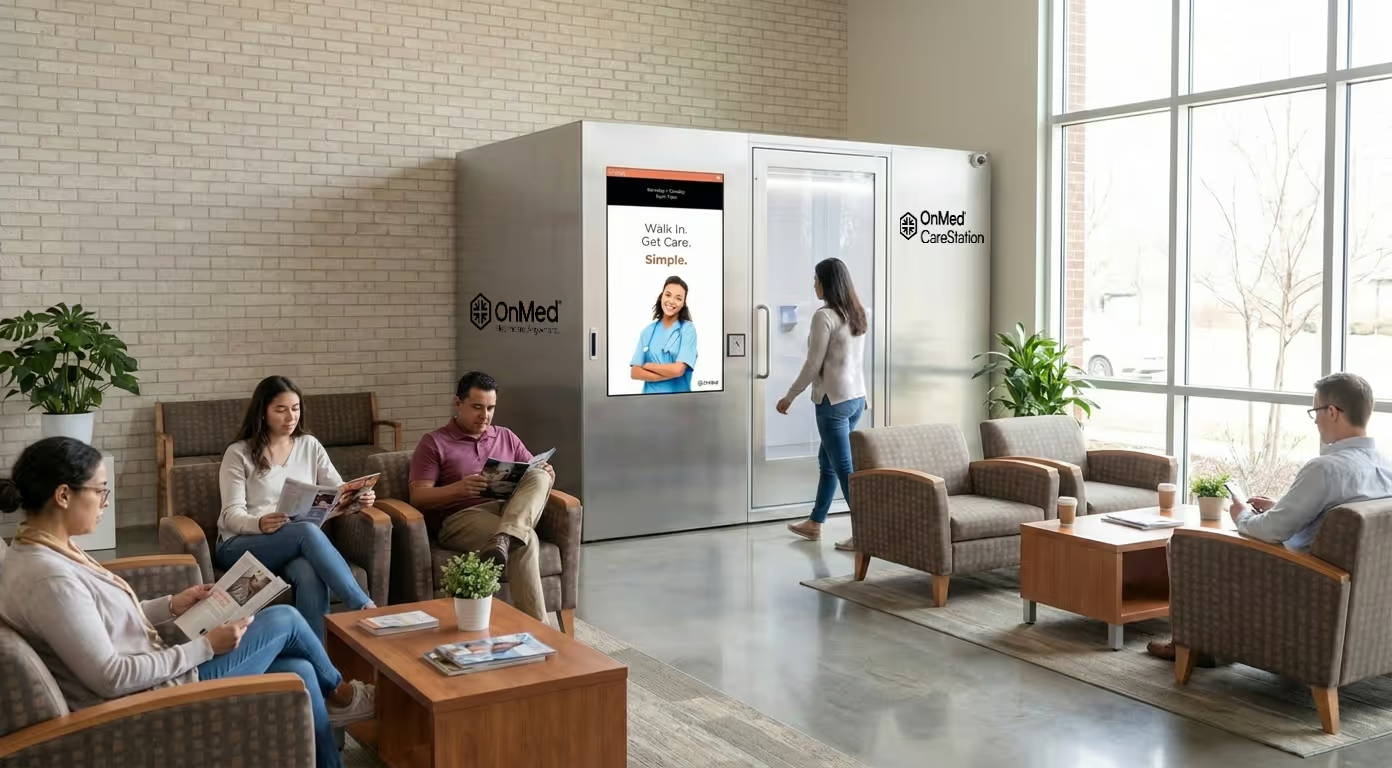
Designed as a private, walk-in clinical environment, the CareStation connects patients with licensed clinicians in real time, supported by integrated diagnostic tools that enable a more complete assessment. Clinicians capture vitals, observe symptoms with greater precision, and conduct a comprehensive evaluation on a 55-inch screen.
The CareStation addresses a wide range of primary and urgent care concerns—including infections, respiratory issues, allergies, headaches, skin conditions, mental health screenings, and more—while also supporting ongoing management of chronic conditions.
Within the CareStation, advanced medical-grade diagnostic tools support accurate, real-time evaluation, including:
Clinicians provide treatment plans, referrals, and e-prescriptions. Every visit includes a full clinical evaluation—enabling care to move beyond access and toward resolution.
The model is also built for scalability. CareStations can be deployed without the real estate, staffing footprint, or buildout timelines associated with traditional clinics, enabling organizations to expand access across distributed populations rather than a single location. Deployment can be completed in as little as 45 days, requiring only an electrical outlet.
For patients, the experience is simple: walk in, connect with a clinician, receive a full evaluation, and leave with a clear next step—often without needing to visit another care setting.
OnMed is a tech-enabled, AI-powered, and always human-delivered healthcare access platform.
For organizations, the impact is operational:
This is not about replacing existing care models. It’s about filling the gap they collectively leave behind.
The proof is in how patients actually behave.
86% of patients are fully treated inside the CareStation without redirection to a specialist, urgent care, or emergency department. That’s not an access metric. That’s a resolution metric—and it’s the number that changes the financial equation for every organization managing a population.
58% of users report they would have otherwise gone to the ED or urgent care. That means more than half of visits represent direct, measurable cost avoidance. For employers watching claims trends, insurers managing avoidable utilization, and health systems absorbing uncompensated care, that deflection compounds quickly at scale.
80% of CareStation patients do not have a primary care physician. For many, this is the first consistent point of care they have ever had, especially in rural areas. The CareStation becomes their medical home—which means previously undetected conditions are identified, managed, and monitored over time rather than presenting later as emergencies.
But the number that says the most about this model isn’t the resolution rate or the deflection rate—it’s the return rate.
Over 35% of patients across all deployments voluntarily return within 12 months—without reminders, without mandated follow-up, and without a chronic condition requiring ongoing management. In a healthcare landscape where urgent care repeat rates sit below 10% and major retail clinic operators have exited the market because they couldn’t sustain engagement, that kind of voluntary return signals something the data alone can’t fully capture: trust.
Convenience gets people in the door once.
A complete clinical encounter—real clinician, real diagnostic tools, real answers—is what brings them back.
The healthcare access problem will not resolve on its own. Demand is increasing, capacity is constrained, and existing models are not designed to meet both at scale.
Organizations that act now have an opportunity to redefine how care is delivered—by prioritizing healthcare access that is available, timely, cost-effective, clinically complete, and built to resolve needs the first time.
To learn how your organization can close the gap between care access and resolution, connect with our team.
We can share how the OnMed CareStation™ is being deployed across employers, health systems, universities, and communities.
Follow along as we continue to redefine the healthcare landscape and bring the OnMed CareStation to communities across the U.S.