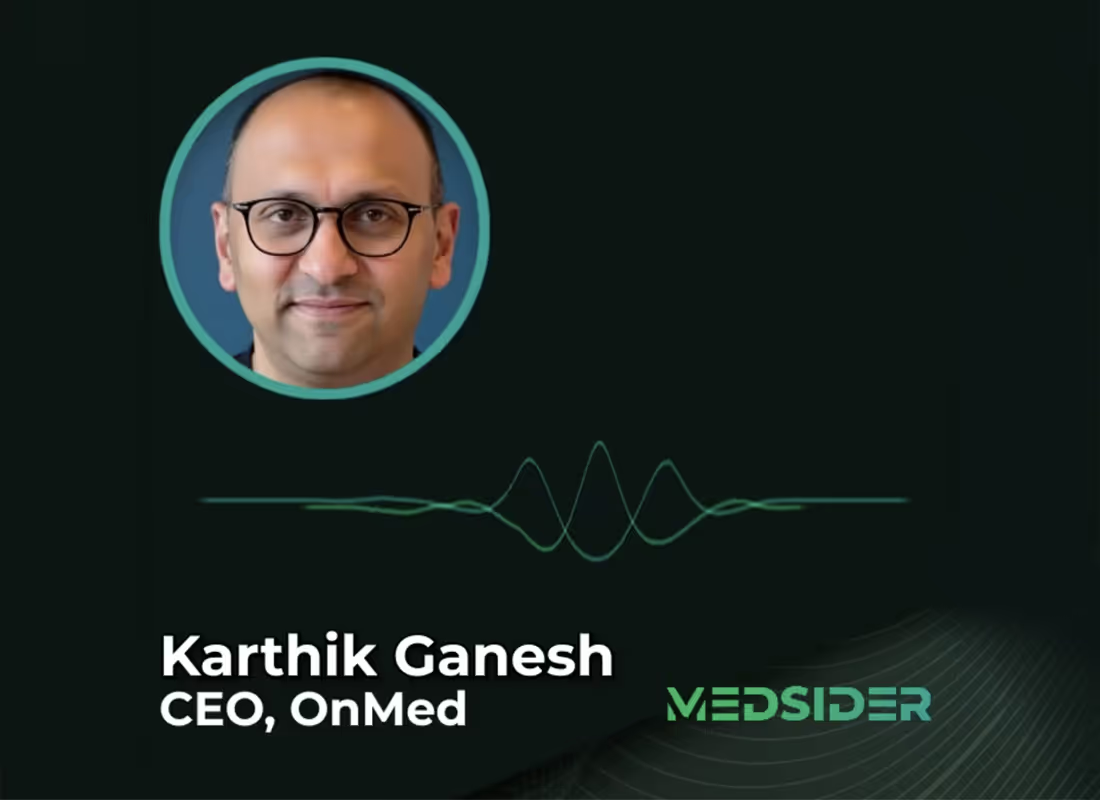
In this Medsider interview, OnMed CEO Karthik Ganesh discusses what he describes as healthcare's "broken doorway," the systemic lack of access to care.
According to Ganesh, 167 million Americans delay care, and for 120 million, that delay is caused by lack of viable access. While the healthcare system continues to invest heavily in treatment and infrastructure, it has not solved how people access care in the first place.
The episode explores how the OnMed CareStation™ addresses that gap. The CareStation is a private, tech-enabled, AI-powered, and human-delivered clinical environment that combines real-time clinician interaction with integrated diagnostic tools to deliver comprehensive care in a single visit.
The conversation also covers leadership, culture, and company building. Ganesh outlines how organizations perform at a high level, how brand shapes execution, and why discipline and constraints drive better outcomes.
"You can't get healthcare to people if people can't access it to begin with. We're so worried about and so focused on all the rooms in the house and upgrading the kitchen and upgrading the master bedroom, we just forget, listen, the doorway is broken."
— Karthik Ganesh, CEO of OnMed
"In America, as consumers, we feel liberated, as patients, we feel claustrophobic. We feel we're cornered, someone's out to get us, Someone is going to screw us over and we don't know where it's gonna come from, so let's get our guard up. There's a reason why every focus group says people don't trust our system."
— Karthik Ganesh, CEO of OnMed
"The [OnMed] deployments have been fascinating, they continue to prove out our perspective that you need to meet people where they are showing up already, you can't have them come someplace."
— Karthik Ganesh, CEO of OnMed
"70% of the people who show up at the ER are for non emergent reasons. They have no business being in the ER, but they are showing up at the ER because they have no place else to go. And we are, so the way we see ourselves is really being able to provide that first level of care or triage as appropriate to either take care of the patient or then, or if needed, redirect them to the appropriate side of care."
— Karthik Ganesh, CEO of OnMed
"Brand and culture are more important than strategy. You have to be crystal clear about your north star. You have to be crystal clear about vocalizing that north star with your team as well as the market at large. You have to know what you're gunning for."
— Karthik Ganesh, CEO of OnMed
"Culture is, it's an equal mix of passion and dispassion. The passion is an unhealthy obsession with where the company is going and what it wants to accomplish. And we don't say, we're very clear at OnMed, we don't have a mission. I see a mission as being stakeholder focused. We have a purpose because what we're doing as societal is much bigger than an individual stakeholder."
— Karthik Ganesh, CEO of OnMed
"The things that are important for me in the culture are a culture of no what ifs, You need to be obsessive about the process. You need to be obsessive about the journey. You can't control the outcome. You can control the journey, so you better do an incredible job with the journey."
— Karthik Ganesh, CEO of OnMed
"Everything needs to be about powering the individual to perform at the top of their game while making them understand that the top of their game only works when they're playing as a part of a team."
— Karthik Ganesh, CEO of OnMed
"You have to be able to vocalize that emotion in the market for your company's brand. You have to be able to vocalize that emotion and create that emotion in your employees or your employer brand. And then you need to put the moving pieces in place that dock into it to make that emotion come to life. In my mind, that is the brand staying ahead of the strategy and the execution."
— Karthik Ganesh, CEO of OnMed
"You can't obsess over your blind spots. You can't convert those blind spots into strengths because I think that is an absolute irrelevant construct. But all of that comes from fundamentally understanding and recognizing your strengths and then playing to those strengths, right?"
— Karthik Ganesh, CEO of OnMed
"The only way to solve our access problems as a country are to completely democratize access."
— Karthik Ganesh, CEO of OnMed
Ganesh frames access as the most critical issue in healthcare.
This leads to delayed diagnosis, increased emergency department use, and higher system costs.
The OnMed CareStation™ is designed to expand access at the point of need.
Each CareStation:
The CareStation brings together traditional care delivery and telemedicine into a single experience.
As shared in the interview:
These metrics reflect improved access and sustained engagement.
OnMed deploys CareStations in environments people already use:
This removes barriers such as travel, scheduling, and time constraints.
OnMed operates as a B2B model, working with employers, providers, payers, and government organizations.
Healthcare funding flows primarily through these stakeholders, making enterprise alignment essential for scale.
Ganesh emphasizes that performance comes from clarity and structure.
Leadership requires defining direction, setting expectations, and maintaining accountability across the organization.
Ganesh defines brand as the emotion an organization creates.
Product, experience, and execution should align behind that definition.
Organizations perform best when individuals operate in roles aligned to their strengths.
Leaders are responsible for enabling that alignment and setting clear expectations for performance.
Ganesh emphasizes discipline in company building.
Constraints improve prioritization and focus, leading to more sustainable outcomes.
Karthik is naturally drawn toward companies that want to challenge the status quo. He is also at a point in his career where it is imperative that his work is deeply purpose-driven with meaningful societal impact, not just a stakeholder one.
Making healthcare more accessible is what drew Karthik to OnMed, a company reimagining America's healthcare access infrastructure in partnership with public and private organizations, while improving health equity in underserved communities. Recognized as a CES 2025 Top Pick, TIME Best Invention of 2025, and a 2026 Edison Award winner, it's the kind of innovation that changes lives.
With a focus on tech-enabled healthcare, Karthik has built and transformed companies, delivered market-leading results, created significant enterprise and investor value, developed high-performing teams, and driven meaningful M&A transactions with strategic investors and private equity.
Along the way, Karthik has had the rare privilege of experiencing the healthcare ecosystem from nearly every vantage point: payer (Aetna, Cigna), pharmacy benefits (EmpiRx Health, Express Scripts), provider-sponsored plans and value-based care (QualCare, CareAllies), consulting (EY, Deloitte), and now care delivery with OnMed.
Beyond the boardroom, Karthik is a prolific writer and speaker on healthcare, leadership, and resilience, with features in leading industry journals and podcasts. He is also the author of The Happiness Model: A Roadmap to Inner Peace.
OnMed is transforming how the world accesses healthcare.
With its patented OnMed CareStation™, an 8×10 foot "Clinic-in-a-Box", OnMed delivers comprehensive, immediate care wherever people live, work, and learn. The OnMed CareStation is a tech-enabled, AI-powered, and human-delivered platform that blends the comprehensiveness of traditional in-person care with the rapid scalability of telemedicine.
Each CareStation serves as a local access point within a scalable, connected grid that delivers everyday healthcare at scale.
Powered by public-private partnerships across insurers, healthcare providers, governments, employers, and educational institutions, OnMed is redefining healthcare access, closing critical gaps, restoring trust, and strengthening the health and economic resilience of communities.
Learn more at onmed.com.
Follow along as we continue to redefine the healthcare landscape and bring the OnMed CareStation to communities across the U.S.