
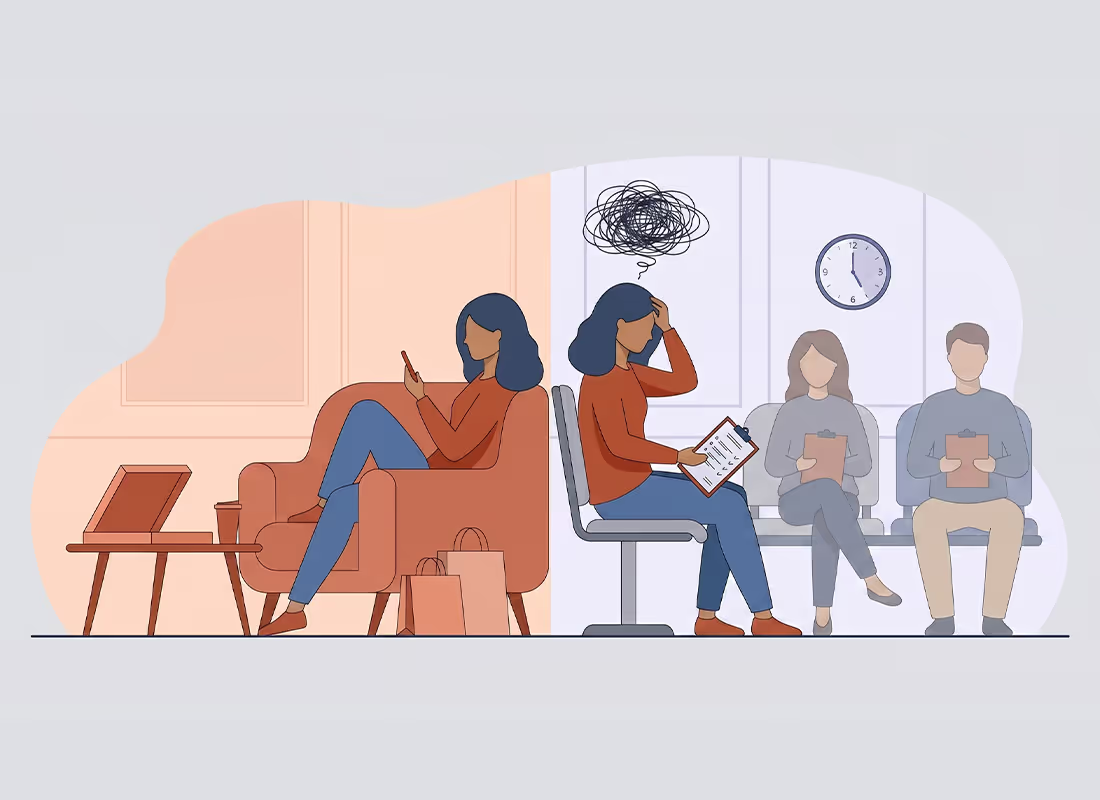
The same person who tracks their DoorDash order in real time, compares hotel reviews across four apps before booking, and expects a same-day Amazon delivery to arrive before dinner — that person also sits in a waiting room for 47 minutes before a five-minute visit they had to schedule three weeks out.
These are not two different Americans. They are the same person, operating in two entirely different systems — one engineered relentlessly around their expectations, the other structured around institutional convenience. One has adapted to them. The other still expects them to adapt to it.
That gap is not just a frustration. For our healthcare system, it is a strategic vulnerability.
For most of the twentieth century, the American patient entered the healthcare relationship with a near-automatic deference. The physician was the authority. The institution was the keeper of information. Trust was structurally embedded — you trusted your doctor because that was what patients did.
The American consumer operates under an entirely different trust architecture. Trust is not assumed; it is earned through consistency, transparency, and performance. A brand earns it by showing up the same way every time. A platform earns it by following through on what it promises. A product earns it by working exactly as described — no surprises, no friction, no apologies.
Today's patient has been shaped by that consumer experience. They read reviews before choosing a provider. They ask questions that previous generations would not have asked. They compare. They switch. They leave — and in a world where CAHPS scores and Google ratings sit side by side, they tell others when they do.
The erosion of automatic deference is not a problem to be solved. It is a shift in the rules of engagement — and the health systems that treat it as an opportunity to earn trust are the ones pulling ahead.

There is perhaps no area where the consumer-patient divide is more stark than time. The consumer economy has spent decades systematically eliminating wait. Same-day delivery. Instant streaming. Two-minute checkout. One-tap anything. Frictionlessness is no longer a differentiator — it is the baseline expectation for nearly every commercial transaction Americans make daily.
Healthcare asks Americans to park that expectation at the door. Months to get an appointment. Then more waiting once you arrive — past the scheduled time, in the exam room, between steps. The friction is baked in at every layer. The dissonance is not subtle.
What makes this particularly consequential is that instant gratification in healthcare is not merely a matter of comfort. Delays in care have measurable clinical consequences. The patient who waits three weeks for a follow-up for chest pain, the person who skips care entirely because booking feels like too much friction, the individual who self-diagnoses on an app rather than navigating an uncertain appointment system — these are not just inconveniences. They are access failures with downstream cost implications for every stakeholder in the system.
The American consumer has been trained to expect options, channels, and convenience. You can buy the same thing in a store, online, through an app, by subscription, or via a third-party marketplace. The product meets you wherever you are. The channel adapts to the behavior.
Healthcare, historically, has operated from a single point of distribution: the clinic. Show up, wait, be seen. There has been one door, and you go through it. New modalities have emerged — telehealth, urgent care, retail clinics — but each carries its own limitations: narrow scope, inconsistent quality, coverage gaps, or access barriers that simply recreate the original problem in a different setting. For most Americans, genuine choice in how, when, and where they access care remains more promise than reality.
The gap between these two columns is not a technology problem. It is a structural and cultural one. The healthcare system was not built to think like a service enterprise. But the people it serves are increasingly expecting exactly that.
The American consumer's tolerance for poor experience has declined sharply and consistently. Bad service is no longer quietly accepted — it is reviewed, shared, and acted upon. The option to switch is always present. Loyalty is earned in the moment, not banked for later. One friction-heavy experience is enough to reroute behavior, sometimes permanently.
Until recently, patients had fewer options. Healthcare inertia is real. Changing a primary care provider is genuinely inconvenient, specialists require referrals, and geographic access can be limited. Tolerance for poor experience was, in some ways, structurally enforced. You stayed not because you were satisfied, but because leaving was hard.
That equation is shifting, but access dysfunction does not spare the wealthy or the well-insured. Long waits, physicians running behind, fragmented follow-up, and a system that treats time as an afterthought are universal experiences. The frustration of a fully insured executive who waited three months for an appointment and still sat in a waiting room for 45 minutes is real. So is the frustration of someone navigating a Medicaid gap. The system fails both — just differently. And as alternatives multiply, the bar for tolerating that failure keeps dropping across every income level.
Access Watch
Ongoing changes to Medicaid eligibility rules are projected to increase the number of uninsured Americans by several million. For health systems, this is not an abstract policy concern — it is a near-term volume and margin reality. More uninsured, non-emergent patients in the ED means more displacement of insured, scheduled patients, higher LWBS rates, and greater pressure on emergency capacity that was not designed to absorb preventable care demand.
Nearly 3 in 4 Americans is managing at least one chronic condition. For this population, the tolerance gap is especially costly. A patient who goes unmonitored between annual visits, or who skips a follow-up because the process felt like too much, is a patient who will eventually cost the system far more. Tolerance for inconvenience, when the alternative is complex chronic disease, is not just a quality-of-life issue. It is a population health issue.
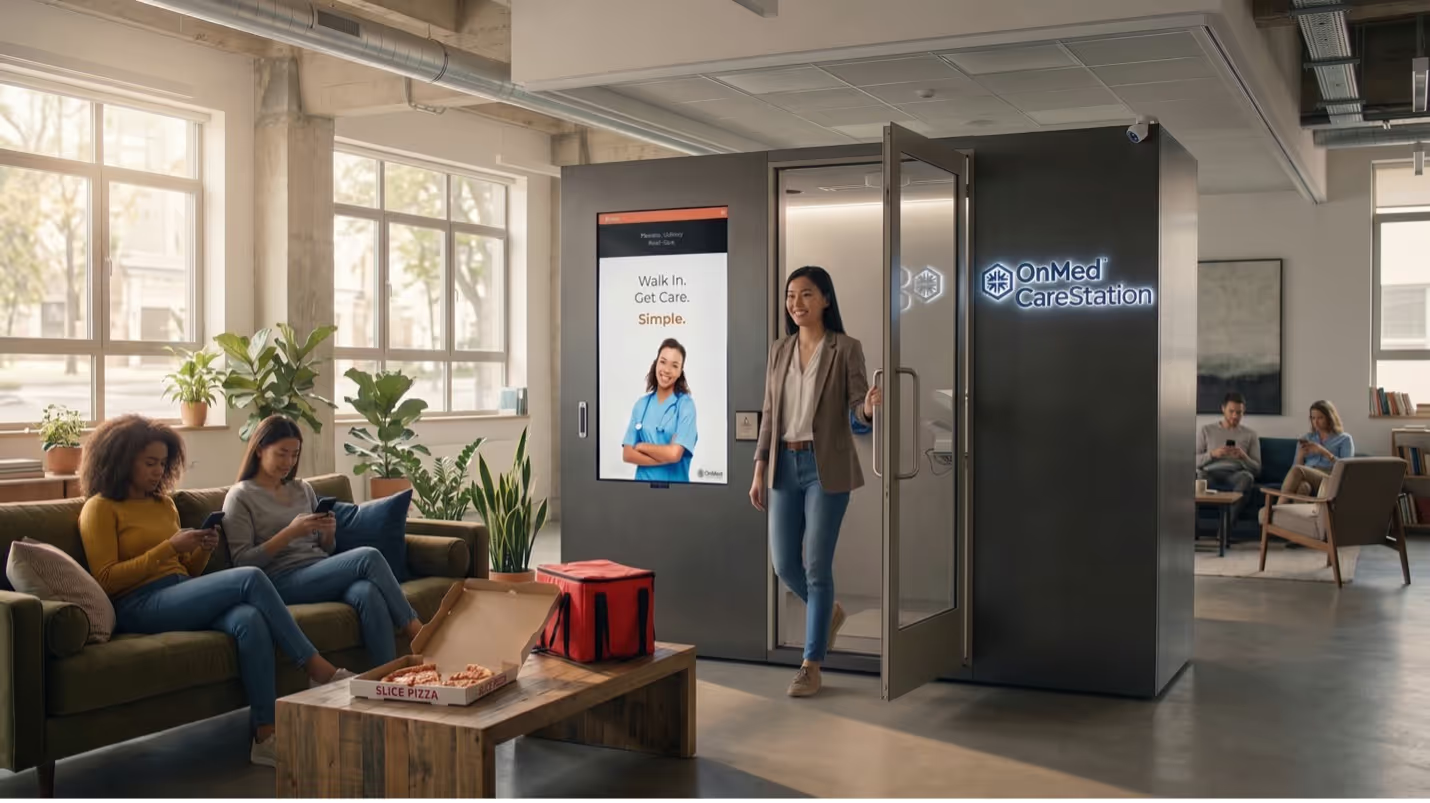
The OnMed CareStation™ was designed with one foundational premise: the person seeking care is the same person who expects an Amazon delivery to arrive on time. Meeting them where they are — not where it is convenient for the system — is not a luxury positioning. It is the central design requirement.
The CareStation's outside-in deployment model places care access in the community — in retail corridors, employer campuses, and public spaces — reducing the geographic, logistical, and psychological friction that keeps people from engaging with the system earlier. No appointment required. No waiting room calculus. Care available when the need is present, not when an opening exists three weeks out.
Inside health system walls, the inside-out model redirects non-emergent volume away from the ED and into an appropriate, lower-acuity setting — one that captures the visit, protects the insured patient's access to the emergency department, and begins the clinical relationship before a condition escalates.
Eighty-six percent of CareStation patients are treated and discharged without ED escalation. That is not just a clinical outcome. That is the consumer expectation — fast, resolved, followed through — finally delivered within a care environment.
What Americans expect from every other service they use, they are now beginning to expect from healthcare. The CareStation is how health systems start meeting that expectation.
There is a version of this story that reads as a lament — the healthcare system has not kept pace with consumer expectations, and the distance between the two is growing. That version is accurate but incomplete.
The expectation gap is also a market signal. Americans are not withdrawing from healthcare because they do not value it. They are withdrawing from the experience of accessing it — the friction, the uncertainty, the sense that the system was built for someone other than them. That is a solvable problem. It is a design problem, an access problem, and a service delivery problem. None of those are permanent conditions.
The health systems positioned to capture the next generation of patients — and retain the current one — are the ones treating the consumer experience and the clinical experience as the same imperative. Because for the person walking through the door, they always have been.
Turn patient expectations into a competitive advantage. Learn how the OnMed CareStation™ makes it possible.
Follow along as we continue to redefine the healthcare landscape and bring the OnMed CareStation to communities across the U.S.